Handicap Pickleball League: Fair Formats, Adaptive Play, DUPR
Handicap Pickleball League: Fair Formats, Adaptive Play, DUPR

A handicap pickleball league can mean two different things, and a good league organizer plans for both. For some players it means leveling the field between unequal skill levels. For others it means adaptive play, where players with disabilities compete under modified rules. This guide covers both, then shows how to keep ratings honest with DUPR so nobody games the system.
TL;DR
- “Handicap” in pickleball usually means one of two things: a scoring or pairing advantage that evens out skill gaps, or adaptive rules for players with physical or cognitive disabilities.
- For skill gaps, tight rating divisions and verified DUPR results do most of the work that a point handicap tries to do, with far less arguing over math.
- USA Pickleball publishes wheelchair rules (including a second bounce) and an adaptive program directory, so adaptive leagues do not need to invent their own rulebook.
- Sandbagging is the main threat to any rating-based league. Verified events, organizer-submitted scores and clear correction rules make it much harder.
- Public facilities and city parks have legal access obligations that affect how they run any league.
Table of Contents
- What people mean by a handicap pickleball league
- Skill handicaps: how they work and where they break
- Sandbagging: the real problem behind most handicap requests
- Why tight divisions often beat a point handicap
- Adaptive pickleball leagues: who can play
- The rules that make adaptive play fair
- Finding or starting an adaptive league
- What facilities and city parks should plan for
- Perspective: what we have learned about fair leagues
- Run your league without the spreadsheet
- A simple setup checklist
- FAQ
- Sources
What people mean by a handicap pickleball league
Search for this phrase and the results are almost all adaptive programs: wheelchair clinics, standing adaptive groups, and inclusive leagues. That makes sense. In everyday American usage, “handicap” in sports is a borrowed term from golf, but in pickleball the word mostly shows up in the context of disability access.
The golf meaning still matters to organizers, though. A player who asks about a handicap league often wants a format where a 3.0 and a 4.0 can share a court and both have a real chance of winning. So there are two design questions:
- Skill handicap: How do we make mixed-ability play competitive and fun?
- Adaptive access: How do we let players with disabilities compete fairly and safely?
The two are not in conflict. Plenty of leagues do both: rating divisions for skill, adaptive rules for access. We cover each below.
Skill handicaps: how they work and where they break
A skill handicap gives the weaker side a head start. The common ways organizers try it:
- Starting score offsets. A lower-rated team starts a game at, say, 3 to 0 against a higher-rated team. The gap is set by the rating difference.
- Partner balancing. Players are paired so each team’s combined rating is close. Draws, round-robin rotations and “high-low” pairing all do this.
- Different targets. One side plays to 11, the other to 9 or 13 for a stronger-side penalty.
These are organizer-designed formats, not official rules, so you need to state them plainly in the league rules before week one. The tradeoffs are practical:
| Approach | Strength | Weak spot |
|---|---|---|
| Starting score offset | Mixed levels can play one match | Needs a rating gap formula everyone trusts |
| Partner balancing | Social, easy to explain | Scores say little about individual skill |
| Rating divisions | Simple, competitive matches | Players near a cutoff may feel stuck |
The weak spot in every handicap system is the same: it only works if the underlying ratings are honest. If a player’s rating is too low on purpose, the handicap rewards them twice. That brings us to sandbagging.
Sandbagging: the real problem behind most handicap requests
DUPR defines sandbagging as intentionally playing below your actual ability to compete in a future event against players you believe you can beat. In a league, that looks like a player who loses a few recreational games on purpose, drops a rating tier, then wins a division and collects the prize.
It matters more in a handicap league because ratings drive the advantage. A fake low rating does not just place a player in an easier division. It also hands them a head start.
What DUPR does about it
DUPR says it prohibits manipulation of ratings, results or data under its Community Guidelines, restricts or suspends violators, uses checks to spot bad behavior, and takes reports at support@mydupr.com. It also states that self-reported scores carry less weight than scores submitted by a club or tournament organizer, and that club and tournament matches carry more weight than recreational ones.
For events, DUPR’s 2026 Verified Event policy summary says participants need an active DUPR+ subscription and an authenticated phone number, a Fairplay Committee reviews events, and noncompliant events can be removed from the program. DUPR also says Verified events count more toward ratings and make sandbagging harder.
What organizers can do
You cannot see inside a player’s head, but you can design a league that makes sandbagging unprofitable:
- Submit scores as the organizer. Results entered by the league carry more weight than self-posted games.
- Require a rating history, not just a current number. A rating that dropped sharply right before registration deserves a conversation.
- Write a placement rule. For example, the organizer may move any player to a higher division after a set number of matches if results are lopsided.
- Publish the rule about prizes. If a player is moved up, say whether standings carry over.
- Know the correction path. DUPR says that for incorrectly submitted club matches you contact the club director, and for imported tournament matches you contact the tournament director first. For recreational or self-posted errors, a correction request needs visible consent from all players to edit or remove the match.
We go deeper on this in how players and organizers run DUPR verified leagues and on catching mistakes in league score reporting. If you are new to the number itself, start with our DUPR rating explainer.
Why tight divisions often beat a point handicap
A handicap tries to make an uneven match even. A division prevents the uneven match in the first place. For most recurring leagues, that is simpler for everyone.
Consider a six-week league with 24 players. If the field spans 2.5 to 4.5, a handicap system must explain a different starting score for most matches. If you split it into three divisions by rating, each match is already close, standings mean something, and nobody needs a calculator on the court.
Good division design includes:
- Narrow bands. Many leagues use half-point or one-point ranges. Our guide to splitting divisions from 2.5 to 4.0+ walks through sizing.
- A minimum size. Divisions with too few players produce repeat matchups and byes.
- Age or format splits where they help. See age divisions in pickleball.
- A ladder option for flexible schedules. Our ladder league guide explains how movement between rungs self-corrects mismatches.
Handicaps still have a place. A social night where a 3.0 plays a 4.5 for fun is a fine use. But for a season with standings and playoffs, the cleaner path is divisions plus verified results.
Adaptive pickleball leagues: who can play
The other meaning of “handicap” deserves precise language. The preferred terms in the sport are adaptive and wheelchair pickleball, and the rules are official, not improvised.
USA Pickleball’s wheelchair guide says an eligible wheelchair player is any person, with or without a disability, who plays while using a wheelchair. Its adaptive resources page shows how broad participation is: the directory includes wheelchair, adaptive-standing, intellectual and developmental disability, youth, adult and Unified programs.
Individual programs set their own entry terms. One example is Adaptive Sports NW, which says no prior experience or physical impairment is needed, welcomes beginners and highly competitive players of all ages, expects athletes to follow sequential commands, and requires membership in the organization. If you run a league, decide your own terms and state them on the registration page.

The rules that make adaptive play fair
Adaptive leagues do not need a separate game. They need a short list of agreed modifications.
Wheelchair rules
USA Pickleball’s wheelchair rules allow wheelchair players a second bounce, treat the wheelchair as part of the player’s body, set limits for serving with the rear wheels, and apply wheelchair-specific non-volley-zone and event rules. On the serve, both large rear wheels must be behind the baseline and inside the correct serving area when the ball is struck. The smaller front wheels may extend into the court.

Court space
USA Pickleball recommends a 44-by-74-foot surface for wheelchair play, and says larger stadium-style courts may measure 50 by 80 feet. A standard court is tight for chair movement, so if you schedule wheelchair matches, plan court assignments with that extra room in mind.
Tell your opponent the rules
Pickleball England’s adaptive guide defines adaptive pickleball as the modified game using equipment, techniques and rule changes so people with physical disabilities can play together. It describes four kinds of activity: open, modified, parallel and specific play. It also recommends that adaptive players tell opponents at the start which adaptive rules apply, and explain them if needed. That habit translates directly to a US league: put the applicable rules in the match instructions and have captains confirm them before the first serve.
The Challenged Athletes Foundation lists similar common accessibility measures: an extra bounce, the chair counted as part of the body, rear wheels behind the baseline, more maneuvering space and adaptive equipment.
Formats to offer
The USA Pickleball directory shows what existing programs run: coaching, equipment loans, sport-wheelchair access, intra-squad tournaments, and wheelchair singles, wheelchair doubles, hybrid and adaptive-standing competition. A practical adaptive league might offer:
- Wheelchair doubles and singles divisions.
- An adaptive-standing division for players with mobility or balance differences.
- A hybrid division pairing wheelchair and standing players.
- Open divisions where adaptive players may enter at their skill level.
Rating-based sorting still applies inside each group. A wheelchair division can have a 3.0 bracket and a 4.0 bracket just like any other.
Finding or starting an adaptive league
Players looking for a league should begin with the USA Pickleball adaptive directory. It lists U.S. programs with descriptions and contact details, and the examples include weekly, seasonal and monthly schedules. Call or email a few and ask about equipment loans, court surfaces and whether you can try a session first.
If nothing is nearby, start small. Gather four to eight interested players, pick a recurring time and a court with room to maneuver, agree on the modifications above, and run a four-week mini-season. Once you have the format, moving to a full registration-based league is a matter of tools, not rules.
What facilities and city parks should plan for
Public entities carry legal obligations. The Department of Justice’s Title II primer says state and local governments must give people with disabilities access to their programs and services, and that a public entity contracting to provide public services must make sure its contractors do not discriminate. The same primer says the 2010 ADA Standards include requirements for court sports, including accessible routes, and that the Standards must be followed when structural changes are needed.
What that means in practice for a parks department or an operator running leagues on its behalf:
- Check the route to the court. The path from parking to the court, the gate and the bench area all count.
- Offer registration that everyone can use. Online sign-up plus a phone or in-person option.
- Put access information on the league page. Surface, court size, restrooms, and whether adaptive divisions run.
- Review contractor agreements. One town’s pickleball operator RFP in Cornelius expects the operator to manage leagues and open play, hold required licenses and permits, maintain insurance, background-check staff who work with children, use its own registration system and coordinate program fees with the town. Add access requirements to that kind of list.
For legal questions about a specific facility, talk to your city attorney or an ADA coordinator. Do not rely on a blog post to decide a compliance question.
Perspective: what we have learned about fair leagues
We build league software around one belief: a season is only worth running if the players trust the standings. Most complaints we hear about leagues are not about the paddle or the court. They are about mismatched divisions, scores nobody checked, and a rating that does not reflect the person across the net.
So our advice is plain. Do not start with a clever handicap formula. Start with honest divisions, organizer-controlled score entry and a rating source players recognize. That is why we built FlexLeague+ with DUPR integration, division management, live standings and score reporting, and why we focus on real competitive seasons rather than casual open play.
Handicap nights are fun, and adaptive divisions are a core part of a healthy pickleball community. Put them on the schedule. Just make sure the structure underneath them is fair, because that is what keeps players coming back for the next season.
— Robert
Run your league without the spreadsheet
If you organize a league, whether a division of 12 or a full season across a facility, FlexLeague+ handles registration, automated scheduling, division management, live standings, playoff brackets and score reporting in one place. It is DUPR approved, and registration fees are collected through Stripe, so you control the revenue. There is no monthly subscription: the league platform fee is $25 one-off per division, as listed on our pricing page.
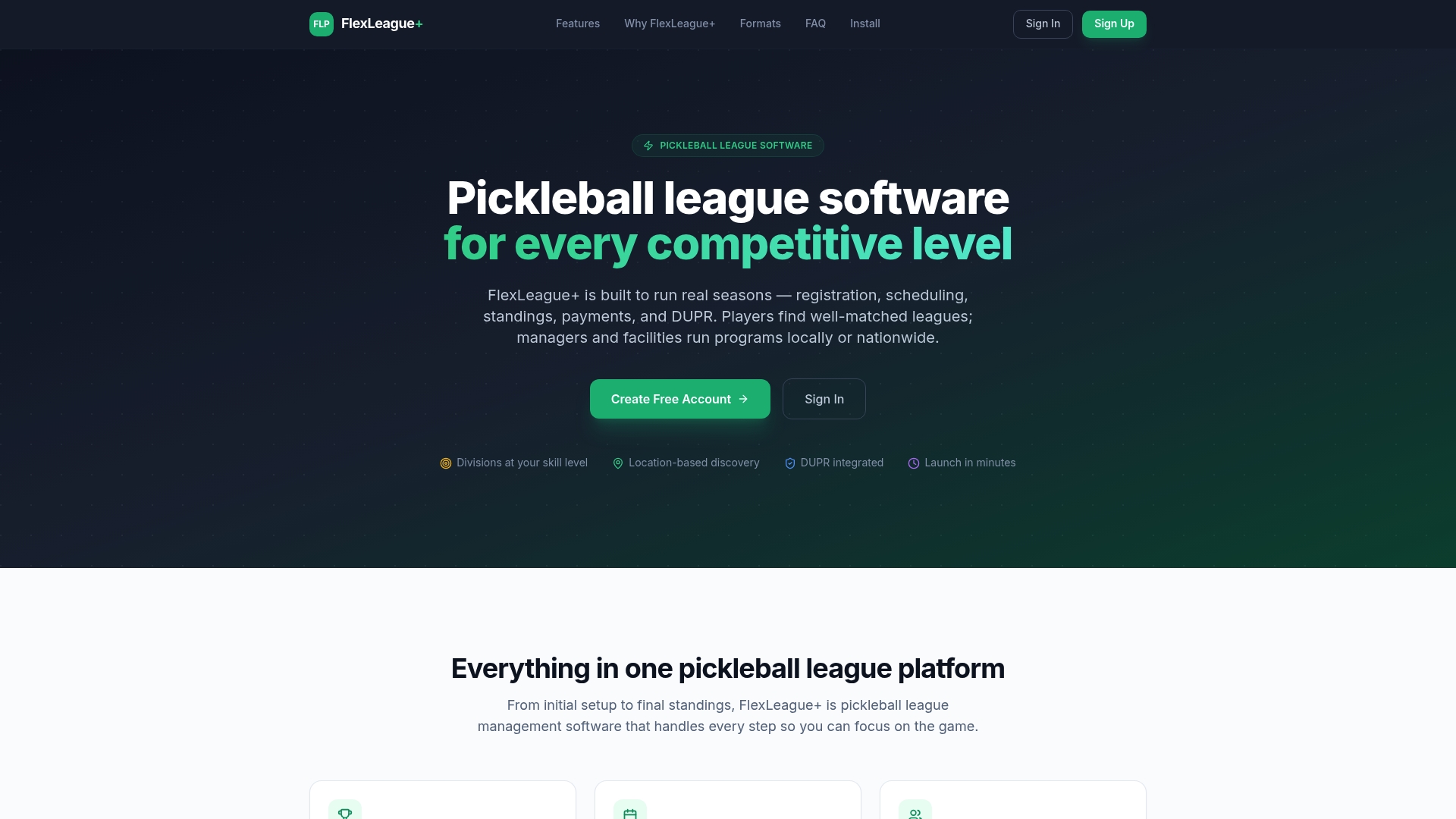
You can set up singles, men’s doubles, women’s doubles, mixed doubles or team leagues, and create separate divisions for each skill band. See how it works on our pickleball league software page, or browse the FlexLeague+ home page to get started.
A simple setup checklist
Whether your league is rating-based, adaptive or both, these steps cover the essentials:
- Decide the purpose. Competitive season, social ladder, or adaptive program. Write one sentence for each.
- Pick divisions. Use rating bands, and add adaptive divisions where you have interest. Check tournament and league formats for playoff options.
- Write the rules. Scoring, tie-breaks, adaptive modifications, placement review and prize eligibility.
- Set the access details. Court surface, size, routes, restrooms and how to request accommodations.
- Control the scores. Have the organizer submit results, and set a window for disputes.
- Plan for corrections. Know who contacts DUPR and how consent is collected for edits.
- Review at midseason. Move players who are clearly in the wrong division, and tell everyone how that works.
If youth play is part of your program, our guide to youth pickleball leagues covers that side, and the rest of our writing lives on the FlexLeague+ blog.
FAQ
Is there an official handicap system in pickleball?
Not in the way golf has one. Skill handicaps in pickleball are formats that individual leagues design, such as starting-score offsets or balanced partner draws. Most competitive leagues rely on rating divisions instead, and they publish their format rules before the season starts.
What is the difference between a handicap league and an adaptive league?
A skill handicap league tries to even out unequal ability, while an adaptive league modifies the rules so players with disabilities can compete. USA Pickleball’s wheelchair rules, for example, allow a second bounce for wheelchair players. A league can run both formats on the same schedule.
How do I stop sandbagging in my league?
Submit scores as the organizer, review rating histories, and write a placement rule that lets you move a player up after lopsided results. DUPR says Verified events and accounts make sandbagging harder, and it accepts reports of manipulation at support@mydupr.com. Tell players about these rules at registration so no one is surprised.
Can players without disabilities join adaptive divisions?
That depends on the program. USA Pickleball’s rules say an eligible wheelchair player is any person, with or without a disability, who uses a wheelchair to play. Other programs set their own membership and participation terms, so state yours clearly on the league page.
Where can I find an adaptive pickleball league near me?
Start with the USA Pickleball adaptive directory, which lists U.S. programs with descriptions and contact details. Contact a few programs and ask about equipment, schedules and whether you can try a session. If none is close, a small organized group can start one using the official wheelchair rules.
Sources
- USA Pickleball: Pickleball Wheelchair Rules for Adaptive Play
- USA Pickleball: Adaptive and Wheelchair Pickleball Resources
- Adaptive Sports NW: Pickleball
- Pickleball England: Adaptive Pickleball Guide, Open to All
- Challenged Athletes Foundation: Adaptive Pickleball
- U.S. Department of Justice: ADA Update, A Primer for State and Local Governments
- Cornelius Parks and Recreation: Pickleball RFP
- DUPR: Integration, Integrity and Info FAQ
- DUPR Help: What if a match is entered incorrectly?
- DUPR: The Biggest Pickleball Tours and Leagues Go DUPR Verified in 2026
- DUPR: Why the Biggest Pickleball Clubs are Becoming DUPR Verified