League Refund Policy Guide for Players and Managers
League Refund Policy Guide for Players and Managers

Most league registration fees are refundable, but only if you request one before the deadline. That deadline is almost always tied to the season start date, not the day you registered. Miss it, and you’re typically looking at a credit or a replacement player, not cash back.
Two quick distinctions worth knowing upfront:
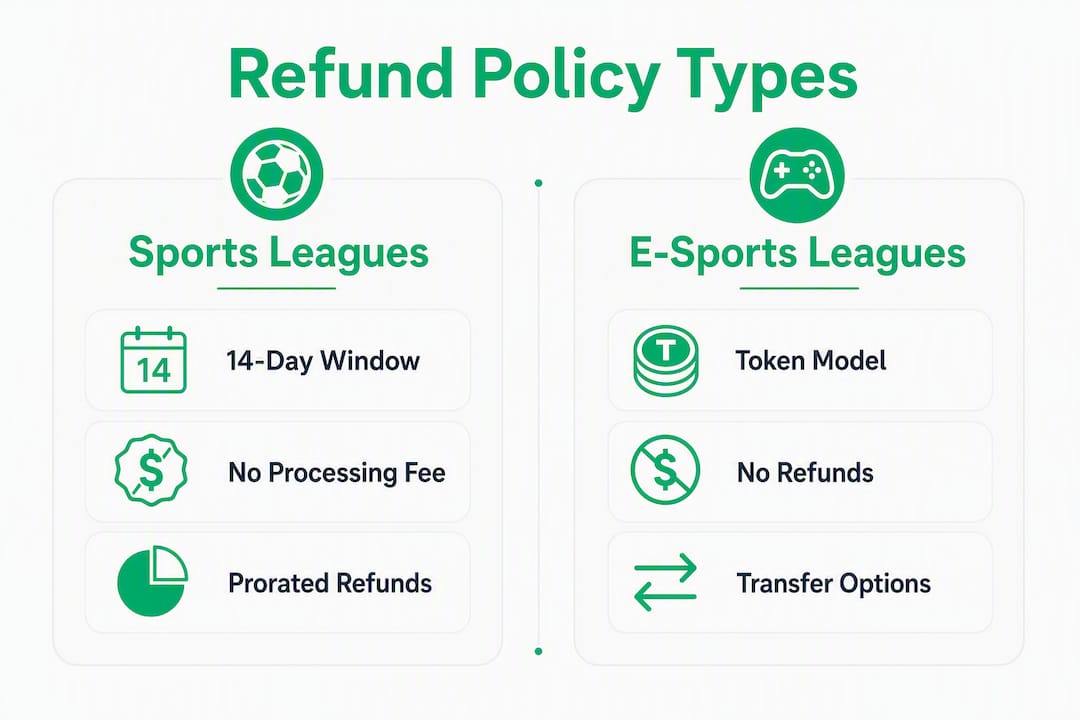
- Community and park-run sports leagues use calendar-based cutoffs, usually 14–30 days before the season starts. S3 Simply Social Sports in Chicago, for example, refunds individual player fees minus processing fees if requested more than 21 days before the first game, and team deposits if requested 30 days out. Expect a deduction for payment processing, commonly 3.49% + $0.49 per transaction, since processors don’t return those fees to organizers.
- Digital and e-sports platforms work differently. Riot Games gives each account three refund tokens for unused content, with one token recouped annually up to that cap. Unused purchases are also eligible for a refund within 14 days, provided the purchase was made within the last 90 days when using tokens.
Your immediate action items: check the league’s posted refund window, confirm whether the refund goes to your original payment method or as league credit, and contact the registrar or commissioner before the deadline if you’re close to it. Platforms like LeagueSafe require commissioner approval for any refund request made after the payment deadline. Flexleagueplus handles payment collection through Stripe and lets organizers set and display refund windows directly on registration pages.
Table of Contents
- What a standard refund policy for leagues looks like
- How refunds are actually processed and what affects your timeline
- Exceptions leagues often accept or deny
- How to request a league refund step by step
- How to handle disputes and chargebacks as an organizer
- A copy-ready refund policy template for league organizers
- How Flexleagueplus helps you enforce refund policies
- Key Takeaways
- The part of refund policy most leagues get wrong
- Flexleagueplus makes refund management straightforward for pickleball organizers
- Useful sources for drafting or reviewing your policy
What a standard refund policy for leagues looks like
League refund rules cluster around a handful of common structures. Knowing them helps players set expectations and gives organizers a benchmark for their own policies.
Common refund windows fall into three patterns: a fixed number of days after registration (often 14 days), a cutoff tied to the season start date (typically 21–30 days before the first game), or a hard “no refunds once the season begins” rule. NYC Footy uses a 14-day window from registration and cuts off refunds entirely within 14 days of the league start, with case-by-case credits for unusual circumstances.
Refund method varies by organizer. Most prefer returning funds to the original payment method when the request is timely. Once the window closes, many switch to league credit only, which keeps money in the program and avoids processor complications. Organizers running tight budgets often favor credits because they’ve already committed to venue costs.
Processing fees are almost universally non-refundable. The merchant pays them regardless of whether a transaction is reversed, so the fee stays out of the refund. Rafa League deducts a flat 3% fee from team refunds made before the deadline, with no refunds at all after Week 1 of play. Full-season cancellations trigger full refunds; mid-season cancellations may produce prorated amounts.
| Policy dimension | Typical sports league | Digital/e-sports (e.g., Riot Games) |
|---|---|---|
| Refund window | 14–30 days before season start | 14 days from purchase (unused content) |
| Refund method | Original payment or league credit | Original payment method |
| Processing fee deducted | Yes (e.g., 3.49% + $0.49) | Varies by platform |
| Who can request | Player or team captain | Account holder |
| Exceptions allowed | Injury, cancellation, relocation | Token-based; 90-day purchase limit |
Standard clauses you’ll see across most policies: prorated refunds for full-season cancellations, no refunds for forfeits or no-shows, replacement-player transfer rules as an alternative to cash back, and host-led exceptions for major schedule or venue changes.
How refunds are actually processed and what affects your timeline
The refund process involves three parties: the organizer who approves the request, the payment processor who executes the reversal, and the bank that posts the funds. Each step takes time, and the timeline compounds.

Who issues the refund depends on the platform. On Stripe-based systems like Flexleagueplus, the organizer initiates the refund through the admin dashboard, and Stripe processes the reversal back to the original card or bank account. Commissioner-approval tools like LeagueSafe add a human review step before any funds move.
Typical timeline:
- Organizer reviews and approves the request: 1–5 business days
- Stripe or credit card processor executes the reversal: 5–10 business days
- Bank posts the credit to the cardholder’s account: up to 10 additional business days
ACH refunds often take longer than card reversals. If your league accepts ACH payments, build that into your stated timeline.
| Refund stage | Typical timeframe |
|---|---|
| Organizer approval | 1–5 business days |
| Processor reversal (card) | 5–10 business days |
| Bank posting | Up to 10 business days |
| Total (worst case) | up to 20 business days |
Processing fees are non-refundable because payment processors charge merchants at the time of the transaction and don’t reverse those charges. The 3.49% + $0.49 example from S3 leagues is representative of what many Stripe-based organizers see. State this explicitly in your policy so players aren’t surprised by a slightly smaller refund than expected.
Pro Tip: Publish a single processing-time promise in your policy, something like “Refunds approved within 7 business days; bank posting may take up to 10 additional business days.” That one sentence eliminates the majority of follow-up emails and significantly reduces chargeback filings.
For organizers, keep transaction IDs, written refund requests, and approval records in one place. You’ll need them if a chargeback is filed.
Exceptions leagues often accept or deny
Most policies draw a hard line, then carve out a short list of exceptions. The key is making those exceptions narrow and requiring documented proof, or you’ll spend the season adjudicating edge cases.
Exceptions organizers commonly honor:
- Full season cancellation by the organizer (almost always triggers a full refund)
- Major venue change or schedule shift that materially affects a player’s ability to participate
- Facility closure outside the organizer’s control
- Documented severe injury or medical emergency (requires a note from a licensed provider)
- Inability to place a free agent into a team after registration closes
- Verified relocation outside the service area before the season begins
Exceptions organizers typically deny:
- Weather delays or individual game cancellations (most leagues treat these as non-refundable unless the entire season is canceled)
- Forfeits or team performance dissatisfaction
- Code-of-conduct violations that result in removal from the league
- Personal schedule conflicts that arise after the refund window closes
The Footy League explicitly excludes weather and facility closures from refunds unless the full season is canceled, at which point prorated refunds or credits become the standard response. That’s a defensible position because partial-refund accounting for weather is genuinely complicated.
Documentation to require for exception claims: medical notes on provider letterhead, proof of relocation (lease or utility bill), or a facility cancellation notice. Set a time limit for submitting exception claims, typically within 7 days of the triggering event, or the window closes.

When refunds are denied, offer a replacement or transfer option. Allowing a player to transfer their spot to another registrant keeps the roster intact and gives the original player an exit without costing the league money.
How to request a league refund step by step
A complete, well-documented request gets processed faster. Here’s the exact sequence.
- Check the posted refund policy. Find the league’s registration page or confirmation email. Note the deadline and the stated refund method.
- Gather your documentation. You’ll need: transaction ID or payment confirmation, your full name and registration details, the league name and season start date, your reason for requesting a refund, and any supporting proof (medical note, relocation document).
- Submit a written request to the designated email address or refund form. Written requests create a paper trail that protects both sides.
- Follow up after the stated processing window. If the policy says 7 business days and you’ve heard nothing, a single follow-up email is appropriate.
What to include in your refund request email:
- Subject line: “Refund Request — [Your Name] — [League Name] — [Season Start Date]”
- One paragraph stating your name, registration date, transaction ID, reason for the request, and preferred refund method
- Attachments: payment confirmation screenshot, any supporting documentation
What happens next: the organizer reviews the request against the posted policy, approves or denies it, and either initiates the refund through the payment processor or offers a credit or replacement option. If your request falls outside the window, ask about a player transfer before escalating.
Pro Tip: If you’re a team captain requesting a refund on behalf of multiple players, list each player’s transaction ID separately. Bundled requests with missing IDs slow down every individual refund in the batch.
How to handle disputes and chargebacks as an organizer
A chargeback is when a cardholder disputes a charge directly with their bank, bypassing the organizer entirely. Banks typically side with the cardholder unless the merchant provides clear documentation. For organizers, chargebacks mean lost fees, potential penalties from the processor, and administrative time.
How LeagueSafe reduces this risk: LeagueSafe requires refund requests before the league’s payment deadline. After that, every refund requires commissioner approval, which forces a human review and creates a documented decision trail. The model exists specifically to prevent players from withdrawing funds after seeing team performance, a form of refund gaming that erodes league finances.
Organizer defense checklist:
- Transaction receipts with timestamps for every registration
- Signed terms-of-service or waiver acceptance (a checkbox at registration counts)
- Written refund request records and your written response
- Roster and attendance logs showing the player participated or was given the opportunity to
- All communications with the player about their request
Respond to chargeback notices within the processor’s response window, typically 7–21 days depending on the card network. Submit the full documentation package, not just a policy screenshot. A policy alone rarely wins a dispute; evidence of service delivery does.
One firm warning: players who file chargebacks to bypass a clearly stated policy often face account suspensions or bans on the platform they used to register. Organizers should note this in their policy language as a deterrent.
A copy-ready refund policy template for league organizers
Paste this into your registration page and adapt the bracketed fields.
[League Name] Refund Policy
Registration fees are refundable, minus payment processing fees (3.49% + $0.49 per transaction), if a written request is submitted more than [21] days before the first scheduled game. Team deposits require a written request more than [30] days before the season start. No refunds are issued after these deadlines or once the season has begun.
Refunds are returned to the original payment method within several business days of approval; bank posting may take additional time. Payment processing fees are non-refundable.
Exceptions may be granted for full-season cancellations, major venue changes, or documented medical emergencies. Exception requests must be submitted within 7 days of the triggering event with supporting documentation.
If a refund is not available, players may transfer their registration to another eligible participant before the season begins. Contact [registrar email] to initiate a transfer.
Chargebacks filed against a valid charge may result in account suspension. To dispute a charge, contact [registrar email] before filing with your bank.
Adaptation notes:
- For tournaments with short registration windows, tighten the window to 7–14 days before the event and remove the team deposit clause.
- For individual registrations vs. team deposits, keep separate deadlines as shown above.
- For league credit instead of cash refunds, replace “returned to the original payment method” with “issued as league credit valid for [one season/one year].”
- Version and date your policy (e.g., “Effective March 1, 2026”) so players know which version applies to their registration.
Place a one-sentence summary directly above the registration button: “Refunds available if requested [21]+ days before the season starts, minus processing fees.” Players actually read that line.
How Flexleagueplus helps you enforce refund policies
Flexleagueplus handles the operational side of refund policy enforcement through its Stripe integration and admin tools, so you’re not managing spreadsheets and manual bank transfers.
- Configure your refund window in the league settings. Set the cutoff date relative to the season start, and the platform displays it on the registration page automatically.
- Set refund defaults. Choose whether approved refunds return to the original payment method via Stripe or post as league credit. This setting applies to all registrations in that league.
- Enable automated confirmation emails. Every registration triggers a confirmation that includes the refund policy summary, so players have it in writing from day one.
- Initiate refunds through the admin dashboard. When you approve a request, the Stripe refund is triggered directly from the platform. The transaction is logged with a timestamp and the refund amount, including any processing fee deduction.
- Record exception approvals. Use the admin notes field to document why an out-of-window refund was approved. That record is your first line of defense if a chargeback is filed later.
- Handle replacement players. When a refund is denied, the platform supports transferring a registration to a new player, keeping your roster count intact.
Flexleagueplus is DUPR approved and connects to Stripe for secure payment collection, which means your refund workflow runs through the same infrastructure your registrations use. No separate tools, no manual reconciliation.
Pro Tip: Enable the audit trail feature and automated refund confirmation emails from the start of each season. If a chargeback arrives three months later, you’ll have timestamped records of the original registration, the refund request, your response, and the Stripe reversal, all in one place.
For a full walkthrough of the pickleball league software features, including payment setup and division management, the product page covers each module in detail.
Key Takeaways
A clear, published refund policy tied to the season start date is the single most effective way to reduce disputes, protect league finances, and keep players informed.
| Point | Details |
|---|---|
| Check the window first | Refund eligibility almost always depends on how many days remain before the season starts, not when you registered. |
| Expect fee deductions | Payment processing fees are non-refundable and will be deducted from your refund amount. |
| Keep documentation | Players and organizers both need transaction IDs, written requests, and approval records to resolve disputes quickly. |
| Use transfers when refunds close | If the refund window has passed, a player-to-player registration transfer keeps the roster intact and avoids a cash dispute. |
| Flexleagueplus enforces policy automatically | Stripe-integrated refund tools, configurable windows, and audit logs reduce chargebacks and manual admin work for organizers. |
The part of refund policy most leagues get wrong
The conventional wisdom says a strict no-refund policy protects the organizer. It does, right up until a player files a chargeback, leaves a public review, or tells their whole pickleball group the league is impossible to deal with. Then the strict policy costs more than a refund ever would have.
The leagues that handle this well do two things differently. First, they publish the policy before money changes hands, not buried in a terms-of-service wall of text, but in a single sentence above the payment button. Second, they offer a transfer option as a default alternative when the refund window has closed. A player who can hand their spot to a friend walks away satisfied. A player who gets a flat “no refunds” with no alternative walks away angry.
The processing fee question trips up a lot of organizers too. Keeping the 3.49% + $0.49 is entirely reasonable; processors don’t return it, so you shouldn’t absorb it. But state it explicitly in the policy with the actual numbers. A player who expected a $60 refund and received $57.42 without explanation will assume something went wrong. The same player who read “minus processing fees of approximately $2.58” before registering will accept it without a second thought.
On the e-sports side, the token model Riot Games uses is worth understanding if you run any hybrid programs. Digital purchases and in-person registrations are fundamentally different products, and treating them with the same refund language creates confusion. If your league has both a digital component and a physical registration, separate the policies clearly.
The bottom line: a fair, clearly communicated policy with a real transfer option is better for retention and reputation than a strict policy that saves you one refund but costs you five future registrations.
Flexleagueplus makes refund management straightforward for pickleball organizers
Running a pickleball league means collecting fees, managing rosters, and occasionally processing refunds. The administrative load adds up fast when you’re doing it manually across email threads and bank transfers.
Flexleagueplus connects registration, payment collection, and refund processing through a single Stripe-integrated platform. You set the refund window once, and it displays automatically on every registration page. When a refund is approved, you initiate it from the admin dashboard and Stripe handles the reversal. Every action is logged with a timestamp, so if a chargeback arrives weeks later, your documentation is already organized.
The platform supports singles, men’s doubles, women’s doubles, mixed doubles, and FLP team formats with DUPR integration for rating-based division management. Automated confirmation emails go out at registration and refund approval, which cuts follow-up inquiries significantly.
If you’re ready to stop managing refunds by hand, start with Flexleagueplus and see how the payment and refund tools work for your league format.
Useful sources for drafting or reviewing your policy
These published policies and platform pages are worth reading before you finalize your own language. Each one handles a specific clause well.
- Riot Games Global Refund Policy — the clearest published explanation of token-based digital refunds; useful if your league has any digital or hybrid components.
- S3 Simply Social Sports Refund Policy — a real community league example with explicit processing fee language (3.49% + $0.49), separate windows for individual players and team deposits, and clean plain-English wording.
- LeagueSafe Refund Policy Help Article — explains the commissioner-approval model and why it exists; useful for understanding dispute prevention workflows.
- NYC Footy Refund and Credit Policy — a tight 14-day window example with case-by-case credit language; good model for urban recreational leagues with short registration cycles.
- Rafa League Refund Policy — covers team deposits, prorated mid-season cancellations, and the 3% processing fee deduction in a single short page.
- The Footy League Refund and Credit Policy — useful specifically for its weather and facility closure language, which is the clause most organizers get wrong.
When you link these on your registration page, frame them as examples rather than governing documents. Your own policy is what applies to your players.
This article provides general information about league refund practices and is not legal advice. Consult a qualified professional or your state’s consumer protection office for guidance specific to your situation.