Organizers: Stop Duplicate Partner Sign Ups With DUPR and Roster Locks
Organizers: Stop Duplicate Partner Sign Ups With DUPR and Roster Locks

Require one verified player account per person, set a hard roster lock, and enforce partner selection through registered accounts. These three rules stop most duplicate partner entries before they start. The rest comes down to workflow: verify identities at signup, run duplicate checks before lock day, and give captains a clear policy to follow.
TL;DR:
- Verifying each player’s account before partner selection and enforcing a strict roster lock drastically reduce duplicate profiles before they occur.
- Using both exact and fuzzy matching for name, email, and phone number, alongside DUPR ID checks, identifies most duplicates with minimal false positives.
- Delaying account creation until after registration and providing clear in-flow instructions help prevent duplicates caused by rushed sign-ups or confusion.
- Regular automated duplicate reports before and after roster lock ensure ongoing detection, allowing quick correction of any issues.
- Clear communication through a one-page reference, reminder emails, and in-app banners helps captains and players understand rules and avoid accidental duplicate registration.
Table of Contents
- Quick checklist: actions to run before and during registration
- Step-by-step registration workflow to design and enforce
- System settings and data-hygiene steps organizers should enable
- Player-facing policies and communications for captains
- Monitoring, conflict resolution, and post-lock cleanup
- Why these controls actually work
- How Flex League Plus helps you lock down clean rosters
- Sources
- FAQ
Quick checklist: actions to run before and during registration
Duplicate partner problems almost always trace back to gaps in the registration window itself, not to bad luck. Closing those gaps takes a short list of habits, applied consistently every season.
- Publish your roster lock date and substitution policy before registration opens, not after complaints start.
- Require a verified account for every player and block guest checkout for partner entries.
- Collect email, phone number, and date of birth as unique identifiers, and prompt for a DUPR ID where possible.
- Turn on duplicate-partner validation if your software supports it, so repeat pairings get flagged automatically.
- Run a pre-lock duplicate report and contact any flagged accounts before the deadline, not after.
Enforcing a hard roster lock and requiring verified accounts before that lock reduces duplicate profiles and cuts the cleanup work that follows registration, according to Pickleball. Skipping any one of these steps tends to push the problem downstream, where it is harder and more time-consuming to fix.
Step-by-step registration workflow to design and enforce
The order of operations matters more than most managers expect. If account creation happens after partner selection, you have already created an opening for duplicates.
- Require account creation first, then open partner selection. Block any path that lets a guest register a partner without an account.
- Validate unique fields at signup, meaning email, phone, and date of birth, and show a clear warning if any of them match an existing record.
- Attempt a DUPR ID match when your platform supports it, so a returning player gets linked to their existing profile instead of a new one.
- Choose your team formation model deliberately. Captain-led registration and free-agent or draft pools each carry different duplicate risks, and Pickleball.com’s organizer guidance notes that the model you pick shapes how duplicates occur and how you catch them.
- Write plain in-flow instructions and error messages so a player who triggers a duplicate warning knows exactly what to do next, rather than abandoning the form.
Captain-led leagues tend to concentrate duplicate risk in one place: the captain re-entering a partner who already has an account. Free-agent and draft formats spread that risk across many individual sign-ups instead, which is why the validation rules need to run at the individual level, not just at the team level.
Pro Tip: Set your DUPR ID field as a soft-required prompt rather than a hard block. Most returning players have one, and matching on it catches duplicates that name spelling alone would miss.
System settings and data-hygiene steps organizers should enable
Your software settings do most of the heavy lifting once the workflow is designed correctly. A handful of configuration choices determine whether duplicates get caught automatically or slip through until someone complains.
- Turn on both exact-match and fuzzy-match detection for name, email, and phone, since name variations alone miss a large share of true duplicates.
- Require verified email and SMS confirmation before a registration counts as complete.
- Tie payments to account identifiers through your payment processor so duplicate charges get flagged at the point of sale, not weeks later.
- Configure validation to block identical partner pairings from registering twice within the same division and season.
- Schedule automated duplicate reports on a recurring basis and use a merge tool that keeps an audit trail of every action.
Combining exact and fuzzy matching catches most duplicate-profile scenarios while keeping false merges rare, since one method alone tends to either miss variations or flag too many legitimate near-matches.
When you do merge two profiles, preserve the payment transaction history and match historical results to the account you keep. Flex League Plus ties registration payments to account identifiers through its Stripe integration, which gives organizers a clear audit trail when a merge or refund is needed. Tools like rotating partner league automation show how DUPR and Stripe data work together to keep records straight through a season.
Player-facing policies and communications for captains
The best technical setup still fails if players and captains do not know the rules. A one-page reference solves most of that problem on its own.
- Distribute a one-page captain reference listing roster deadlines, substitute rules, and account verification steps, since Pickleball.com’s guidance credits this single document with preventing most mid-season disputes.
- Send a registration confirmation email that includes a short partner-account checklist, so players can self-check before lock day.
- Provide an account-repair link players can use themselves if they discover they have two profiles, cutting down on support requests.
- Post in-app banners and send reminder emails in the days before roster lock, prompting anyone still unverified to finish the process.
A guide like Flex League Plus’s roster management resource gives captains a template to follow instead of leaving them to guess at your rules mid-season.
Monitoring, conflict resolution, and post-lock cleanup
Detection does not stop when registration closes. Run a duplicate report right before roster lock, then run it again immediately after, checking for overlaps in email, phone, and DUPR ID.
- Run the pre-lock and post-lock duplicate reports on a fixed schedule so nothing depends on someone remembering to check.
- Contact any affected players directly, request proof of identity if the match is unclear, then merge or deactivate the duplicate account.
- Record every merge action and map the retained account to the correct scores and payment history.
- Watch for repeated attempts at the same duplicate pairing, which usually signals deliberate misuse rather than an honest mistake, and apply the penalties in your published rules.
Pro Tip: Keep your merge log separate from your general admin notes. When a scoring dispute comes up months later, you want a fast answer for exactly which account absorbed which match history.
Why these controls actually work

Most duplicate partner problems are not caused by bad actors. They come from rushed sign-ups, unclear instructions, or software that lets a partner get added before an account exists. The fix is rarely more enforcement after the fact. It is tighter design at the point of registration.
Flex League Plus builds these controls into the registration flow itself: account creation before partner assignment, DUPR integration for identity matching, and Stripe ties that keep payment records honest through a merge. The rotating partner automation and DUPR verification guides on the platform’s blog walk through the setup in more detail for organizers building out a new season.
— Robert
How Flex League Plus helps you lock down clean rosters
Manual spreadsheet checks catch duplicates eventually, usually after a captain has already complained. Flex League Plus runs the checks at registration, tying DUPR ID matching, verified accounts, and Stripe payment records into one workflow, so a duplicate pairing gets flagged before it ever reaches your roster lock date.
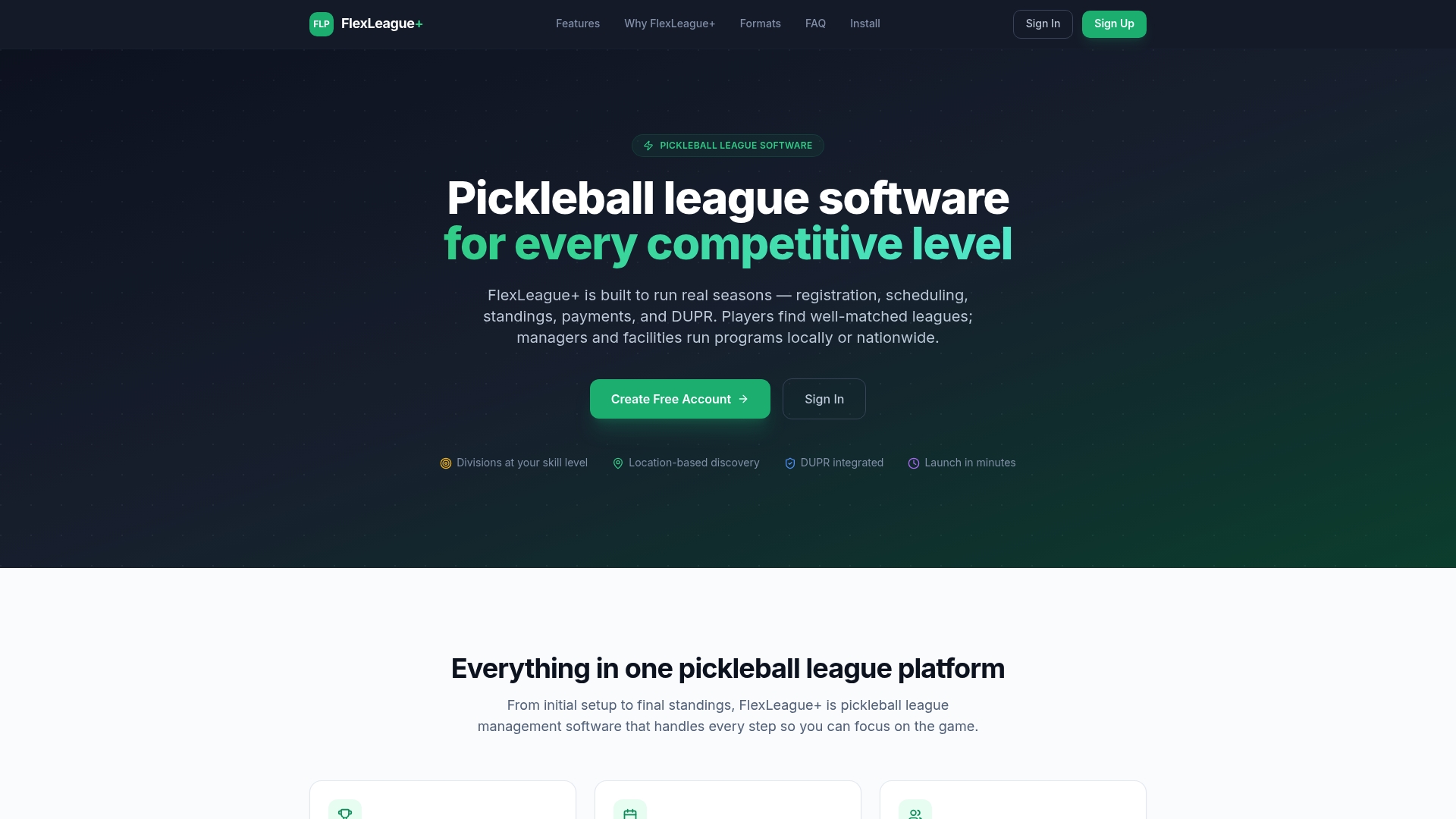
Organizers pay a league platform fee of $25 one-off per division, with no monthly subscription required. Visit the pickleball league software page to see the registration and verification tools in action, or head to Flexleagueplus to get your next season set up.
Sources
For roster lock and account-requirement guidance, see Pickleball.com’s organizer guide. For registration setup and DUPR verification, see Flex League Plus’s step-by-step registration guide and DUPR-verified league resource. For broader identity-verification practices from adjacent operators, see StudioFlare’s attendance guidance.
- Pickleball
FAQ
What is the fastest way to stop duplicate partner sign-ups?
Require a verified account before anyone can select a partner, and set a hard roster lock date that everyone knows in advance. Combining those two rules with software-side duplicate checks handles most cases before they become a problem, according to Pickleball.com’s organizer guidance.
Should I use captain-led or free-agent registration to reduce duplicates?
Both formats work, but they create different duplicate risks: captain-led leagues concentrate risk in one re-entry point, while free-agent pools spread it across many individual sign-ups. Pickleball.com’s guidance recommends choosing the model deliberately rather than defaulting to one.
How does DUPR integration help prevent duplicate partner profiles?
Matching a new registration against an existing DUPR ID lets your system recognize a returning player instead of creating a second profile for them. Flex League Plus uses this matching as part of its registration workflow, alongside verified email and phone checks.
What should I do if I find a duplicate account after roster lock?
Contact the affected players, ask for identity confirmation if the situation is unclear, and merge the accounts while preserving payment and match history on the retained profile. Recording the merge in an audit trail protects your standings and refund records if the dispute comes up again later.
How do I communicate duplicate-partner rules to players without confusion?
Publish a one-page captain reference before registration opens, covering roster deadlines, substitution rules, and verification steps. Follow it with a confirmation email checklist and reminder banners as roster lock approaches, so no player is caught off guard.